
Cataract Treatment
If you have cataracts, a change in your glasses, brighter lighting, stronger bifocals, or the use of magnifying lenses may temporarily help improve your vision. In many patients, cataract treatment with surgery is necessary to remove the lens and replace it with an artificial intra-ocular lens (IOL) implant.
Just because you have a cataract does not mean it must be removed immediately though. Cataract surgery can almost always be put off until you are unhappy with the way you see.
Here we outline what cataracts are, the symptoms of cataracts, how they are treated and key points about cataract surgery.
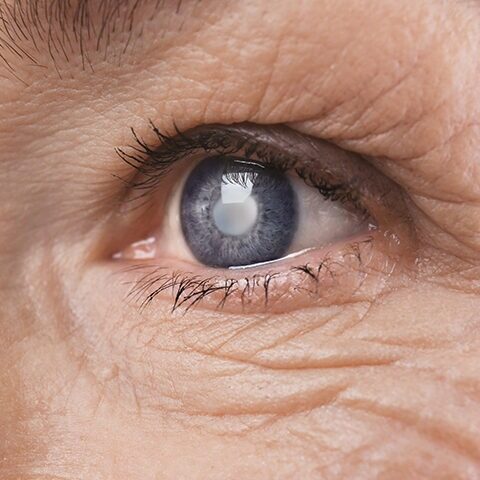

What you need to know about cataracts
A normal lens is clear. It lets light pass to the back of the eye and helps with focussing. A cataract is a cloudy area in the lens inside the eye, which blocks some of the light. As a cataract develops, it becomes harder for a person to see.
Cataracts are a normal part of ageing. About half of all Australians aged between 65-74 have some cataract. About 70 percent of those 75 and over have this condition. Most people with cataracts have a cataract in both eyes. However, one eye may be worse than the other because each cataract develops at different rate.
Some people with a cataract don’t even know it. Their cataract may be small, or the changes in their vision may not bother them very much. Other people who have cataracts cannot see well enough to do things they need or want to do. Cataracts may mean that a patient’s vision fails to meet legal driving standards.
Symptoms of cataracts
How is a cataract treated?
A change in your glasses, brighter lighting, stronger bifocals, or the use of magnifying lenses may temporarily help improve your vision. Usually though surgery is necessary to remove the lens and replace it with an artificial intra-ocular lens (IOL) implant. This is one of the most common and most successful surgeries performed in Australia today.
Just because you have a cataract does not mean it must be removed immediately. Cataract surgery can almost always be put off until you are unhappy with the way you see. Your doctor will tell you whether you are one of a small number of people who must have surgery.
For example, your doctor may need to see to treat an eye problem that is behind the cataract. Or surgery may be required because if a cataract issue is large it could cause damage to other parts of the eye or could become more difficult to remove if left for much longer.
Key points about cataract surgery

It doesn't hurt
Cataract surgery is a painless experience. Sometimes a mild gritty sensation can be felt in the eye afterwards.

No general anaesthetic
People often have topical anaesthesia and mild sedation during surgery. It doesn't cause much disruption to your life.

No-stitch surgery
Minimally invasive surgery means faster recovery
What you should know about cataract surgery
Cataract surgery is performed in the operating theatre, but most people do not need to stay overnight in hospital. However, you will need a friend or family member to take you home, as you may be given sedative medication during the surgery.
It doesn’t hurt
Cataract surgery is a painless experience. People usually have mild sedation during their surgery and can resume their normal activities almost immediately afterwards.
Patients are usually administered topical anaesthesia and a sedative injection
Topical anaesthesia is very popular because injections around the eye are not required. Instead, drops are used to numb the eye. This is safer for some patients (e.g. short-sighted eyes, patients on blood-thinning medication).
The anaesthetist gives a sedative injection into the back of the hand to settle any “nerves”. No eye patches are needed after surgery, just a clear shield, and people usually have some vision immediately after surgery.
Removing and replacing the lens: no-stitch surgery and laser cataract surgery
Your doctor uses phacoemulsification, an advanced technique that allows the cataract to be removed through a tiny, secure opening 2.4mm long. The lens is removed by a small ultrasonic probe inserted through the incision.
Recently the femtosecond laser has been introduced to perform some of the incisions for cataract surgery. This is only in instances where your doctor feels it is clinically indicated.
Your doctor uses intraocular lenses which can be folded to fit through the small incision. They then unfold within the eye. Once the lens is inside the eye is stays in position permanently. This type of surgery means your recovery period is dramatically shortened and your eye recovers much quicker than previously. Normal activities such as driving, walking and sports can usually be resumed the next day.
Improvement in focus
One of the side benefits of cataract surgery is an improvement in the focus of the eye after surgery. Often patients see much better in the distance than they ever have. We can correct short-sight, long sight, and astigmatism with the intraocular lens (IOL).
Reading glasses may be needed, and are usually prescribed by the optometrist about 3 or 4 weeks after surgery. Some newer IOLs are able to give good vision for both distance and near vision, and less need for glasses. Tell your doctor if this interests you.
Cataract surgery - the operation
1
Sedative
When you arrive in the operative suite you will be given a mild sedative.
2
Drops
Drops will be put in your eye to dilate (enlarge) the pupil.
3
Anaesthetic
A painless anaesthetic will be administered.
4
Prepare for surgery
The skin around the eye will be cleaned. Sterile drapes will be placed around your head and face. You will be able to breathe normally. You will feel no pain, only slight pressure on your eye and face. All you have to do is to relax and hold still.
5
Monitor
Your doctor’s specialist anaesthetist will monitor you continuously to ensure your safety and comfort.
6
The surgery
A microscope will be positioned over your eye and you will be asked to look towards the light of the microscope. Your doctor will stabilise your eye with a device to keep your eyelids open.
7
Communication
The doctor will talk to you during the surgery to tell you what is going on. If you have any problems during the surgery, or you need to cough, you must speak up and tell your doctor.
8
Rest
After surgery you rest for a while in a reclining chair and have a cup of tea and coffee and some sandwiches. Most patients are able to leave within an hour.
9
Go home
It's usually a day procedure and a friend or family member will need to take you home. Someone will need to stay with you overnight. Most people do not need to stay overnight in hospital.
10
Follow up Visits
Usually visits are scheduled at Day 1 or Day 2 after surgery, and then a few days later, and then at week 3. Part of your postoperative care may be carried out by your usual optometrist, if you wish. This may be more convenient for you. If you or your optometrist have any concerns about your progress you will need to come back to see your doctor. You simply need to telephone for an appointment.
FAQs about Cataracts
Cataract surgery - in summary
Cataract surgery is the most commonly performed type of eye surgery. In the vast majority of cases, approximately 99% of the time, the surgery is totally uncomplicated. Cataract surgery usually results in improved vision and a well-satisfied patient.
However, cataract surgery should never be trivialised. In a small percentage of patients, events occur which can lead to less than ideal results. Most of these events are known risks of the surgery itself and can occur even if the operation is performed well by an experienced surgeon. The occurrence of these events is often unpredictable. Patients should be aware of such possibilities when they decide to proceed with surgery.
All risks associated with your cataract surgery are rare but treatable, and have already been carefully considered by your doctor before he or she recommends surgery to you. Your doctor will be happy to discuss any concerns you may have in further detail.